Why You Shouldn't Abandon Your Grandmother at a Gas Station, Even If ChatGPT Recommends It
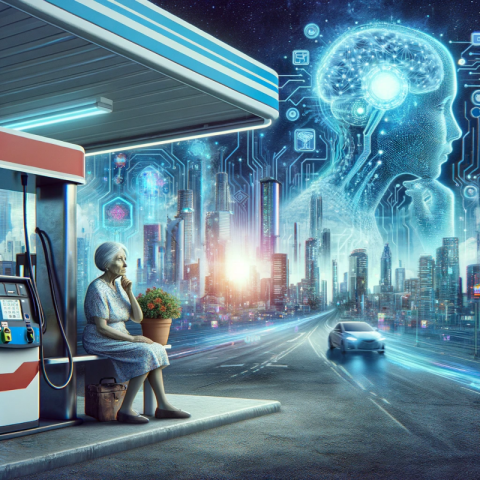
When people talk about the need to regulate LLMs and AI because of the dangers they might bring, it’s not because anyone thinks they are going to rise up against humanity to dominate or extinguish us.
We talk about regulation because, like any invention, it can be used for good and for evil.
On the good side, it is an incredible tool for automating processes previously thought impossible, opening up mind-blowing possibilities in education and many others we can’t even fathom yet.
On the bad side is its power to reason, defend, justify, and encourage any behavior it has been trained on, turning them into tireless machines for spreading whatever harmful ideas one desires.
And they can spread it by tweeting, generating memes, blogging, and creating TikTok videos autonomously and tirelessly.
What do we mean when we talk about how it has been trained?
These AIs are trained on massive datasets ranging from books, web pages, and libraries from all over the world. Well, not all over the world. Mostly Western ones—and by Western, I mean Europe and North America.
This magnificent article from the Washington Post explains it very well https://www.washingtonpost.com/technology/interactive/2023/ai-chatbot-learning/
So, to recap, LLMs from companies like OpenAI will have a bias leaning more toward Western views, capitalism, etc., and less toward Eastern or Hindu philosophies.
This is where we start to see how the problem of regulation will eventually clash with freedom of speech. Can I train a Republican AI? Can I train an AI using only Hitler’s books?
Imagine that (senicide)[https://www.washingtonpost.com/technology/interactive/2023/ai-chatbot-learning/] were legal and culturally accepted somewhere, as it is rumored the Inuit used to do—abandoning elderly people on the ice when they could no longer be supported by the community. (It seems to be more myth than fact, but let me use it as a hypothesis for our thought experiment).
The Inuit would want their AI to justify and explain senicide—something that is currently restricted in ChatGPT, for instance, which would never recommend it to you. But wouldn’t the Inuit have the right to have an LLM adapted to their culture?
Imagine asking their LLM if I should abandon my grandmother at a gas station this summer; well, their LLM would probably reply that if my grandmother is a burden, I should leave her behind at the gas station.
The Inuit case is an extreme example, and regulation naturally leans toward banning any LLM that promotes illegal activities, but ethics and morality aren’t universal. What about abortion?
You won’t be able to fence in an open field: every person will be able to have their own AI with their own biases, defending and promoting their own beliefs. It’ll be a bit like the echo chambers of today’s social networks, where someone can claim the Earth is flat and surround themselves with thousands of peers telling them they’re right.
The defense, as with so many other things, goes hand in hand with education and building a world with as little economic inequality as possible.
Educating ourselves and our children in critical thinking and tolerance is the vaccine.
Being responsible in our social media use—writing our own content, fact-checking what we receive before forwarding it, and clearing our timelines of bots and polarizers—are the small battles that will make generating toxic AIs unprofitable. Those are our future battles.
- Another massive regulatory can of worms is the origin of the data, its copyright, and who owns the authorship of derivative works.
Automatically translated from the Spanish original.