Where to sit on a high-speed train: what Spain's three fatal high-speed accidents teach us
When you book an AVE ticket you ask sensible questions: will I be able to work, window seat, quiet coach, is the buffet car close. Nobody asks which coach to sit in to survive.
Until January of this year that question would have sounded like paranoia. Since 1992 Spain has sold high-speed rail as something as safe as it is boring. And then three things happened: Adamuz in January, Urda in October and, in the background, the memory of Angrois in 2013. One hundred and ninety-five deaths between the three. The question stopped sounding like paranoia and started sounding like common sense.
So I went through the three accidents coach by coach: which vehicles left the rails, where the impact entered in each case, which ones were destroyed and which ones reached a station under their own wheels. The point is something very practical: if you take an AVE tomorrow, where do you sit?
The summary, in one image
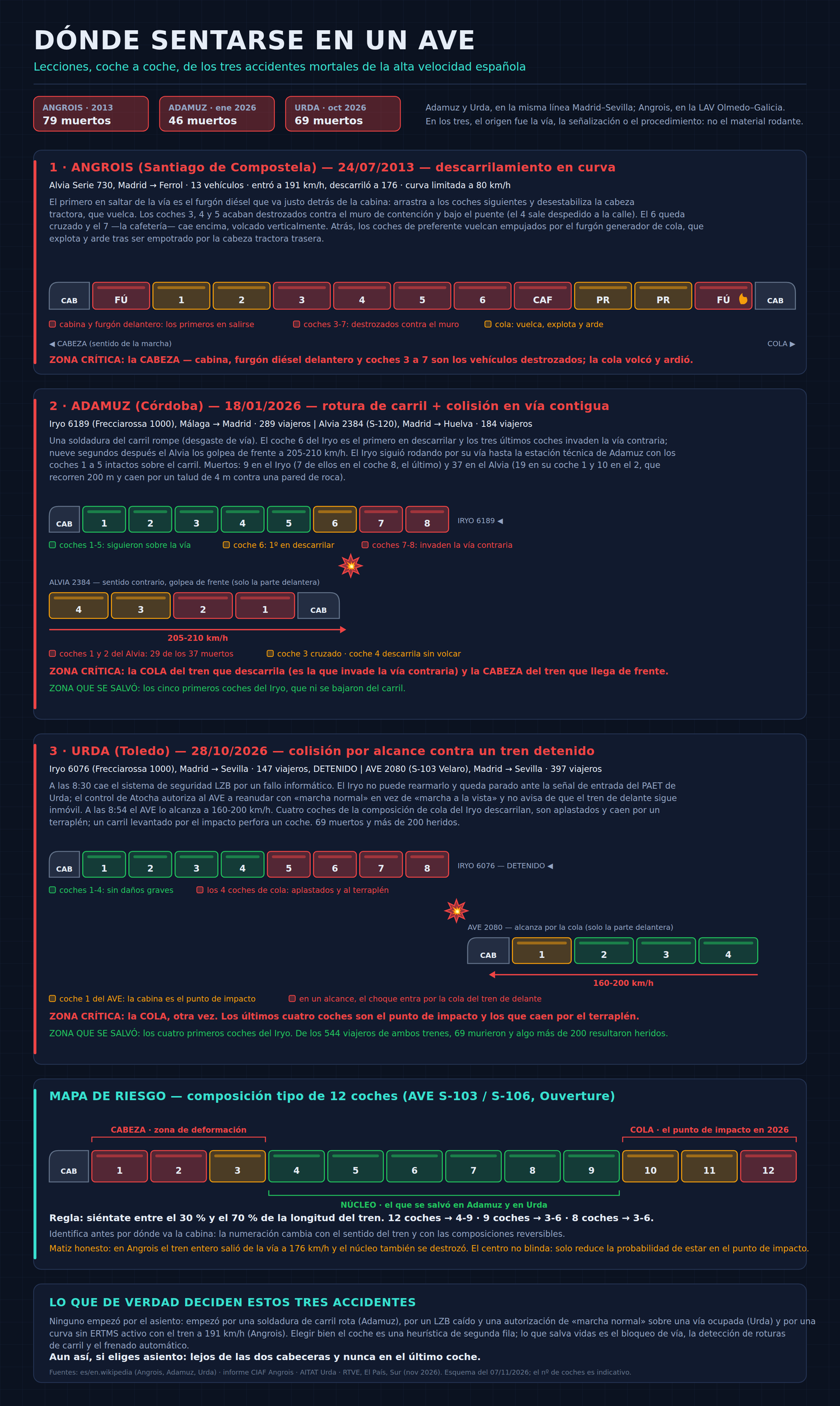
Three accidents, three different lessons
Angrois, 24 July 2013: the overspeed derailment
The Madrid–Ferrol Alvia was a train of thirteen vehicles: two power heads, two diesel generator trailers and nine intermediate coaches. It entered the curve on the approach to Santiago at 191 km/h where the limit was 80, and began to derail at 176 km/h.
What matters is the order in which it left the track:
- The front diesel trailer — right behind the cab — was the first to leave the rails. It dragged the following passenger coaches and destabilised the front power head, which rolled over.
- Coach 4 was thrown onto the retaining wall and ended up in the street. Coaches 3 and 5 rolled over and were torn open against that same wall.
- Coach 6 ended up broadside, and coach 7 — the buffet car — fell on top of it and rolled vertically.
- Behind them, the preferente coaches overturned, pushed by the rear generator trailer, which exploded and caught fire after being rammed by the rear power head.
79 dead and 144 injured out of 224 people on board.
The lesson: in a fast derailment the critical zone is the head, and the accordion effect eats its way backwards from there. But the tail wasn’t safe either: it rolled over and burned. There was no good spot here; there were only less bad ones.
Adamuz, 18 January 2026: hitting a train that invades your track
Iryo 6189 (a Frecciarossa 1000 of eight coaches, 289 passengers and 5 crew, Málaga–Madrid) ran over a broken rail caused by a faulty weld at 205 km/h. At 19:43:34 the first axle of coach 6 left the rails. The last three coaches — 6, 7 and 8 — derailed and invaded the adjacent track. And the first five stayed on their own track, undamaged, all the way to the Adamuz technical station: the train kept running with three coaches dragging behind it.
Nine seconds later Renfe’s Alvia 2384 (184 people on board) arrived at 205-210 km/h and struck coaches 7 and 8 of the Iryo.
- The two front coaches of the Alvia — 37 people in the first, 16 in the second — travelled some 200 metres off the track and fell down a four-metre embankment into a rock wall.
- The third coach ended up broadside between the tracks and the fourth derailed, but without rolling.
46 deaths. 37 were on the Alvia: 19 in its coach 1 and 10 in its coach 2. Nine people died on the Iryo, seven of them in coach 8, the very last one.
The lesson: in a head-on collision the impact enters through the cab. The Alvia’s first two coaches hold 29 of its 37 deaths. And on the Iryo, the five coaches that never left the rails came through almost unscathed.
Urda, 28 October 2026: the rear-end strike
At 8:30 in the morning the LZB — the safety system that brakes the train by itself — went down across a 64 km section because of a computer failure. Iryo 6076 (147 people on board) could not reset it and stayed stopped before the home signal at Urda. Atocha control authorised the AVE 2080 (397 people) to resume with “normal running” instead of “cautious running”, without telling it that the train ahead was still motionless. Its screen showed Velocidad Meta 000, which means precisely that: there is a train in front.
At 8:54 the AVE caught the tail of the Iryo at 160-200 km/h. The four coaches of the rear formation derailed, were crushed and fell down an embankment. A rail lifted by the impact pierced one coach. 69 dead (40 men and 29 women) and more than 200 injured out of 544 travellers across both trains. The AVE driver died, as did two Iryo crew members; one of the victims was in the last coach of the Iryo.
The lesson: in a rear-end collision the impact enters through the tail of the stationary train. The Iryo’s first four coaches are the ones that survived.
The pattern: the core
Overlay the three cases and the coincidence is crude but real:
| Zone | Coaches (12-car formation) | What happened to it in the three accidents |
|---|---|---|
| Head | 1-3 | Destroyed at Angrois (where the derailment starts) and at Adamuz (29 of the Alvia’s 37 deaths in its first two coaches) |
| Core | 4-9 | The only zone that was never the primary impact point in any of the three |
| Tail | 10-12 | Crushed and thrown down the embankment at Urda; the deadliest coach at Adamuz was the 8, the Iryo’s last; at Angrois it rolled and burned |
Practical rule: sit between 30 % and 70 % of the train’s length. On a 12-coach AVE, coaches 4 to 9. On an 8- or 9-coach formation, coaches 3 to 6.
Two nuances that matter more than the rule:
- Find out which end the cab is on. Coach numbering changes with the direction of travel and with reversible formations. Sitting in “coach 5” means nothing if you don’t know whether the 5 is at the front or the back.
- The centre doesn’t shield you. It offers no protection against fire (Angrois), against the accordion effect, or against your coach going down an embankment. It lowers the odds of being at the impact point. That’s all.
And the uncomfortable conclusion: in all three accidents the origin was the track, the signalling or the procedure — a badly made weld, an LZB that drops, an authorisation given over the radio — not the rolling stock and not the seat. No personal choice fixes an infrastructure failure.
What order of magnitude are we talking about?
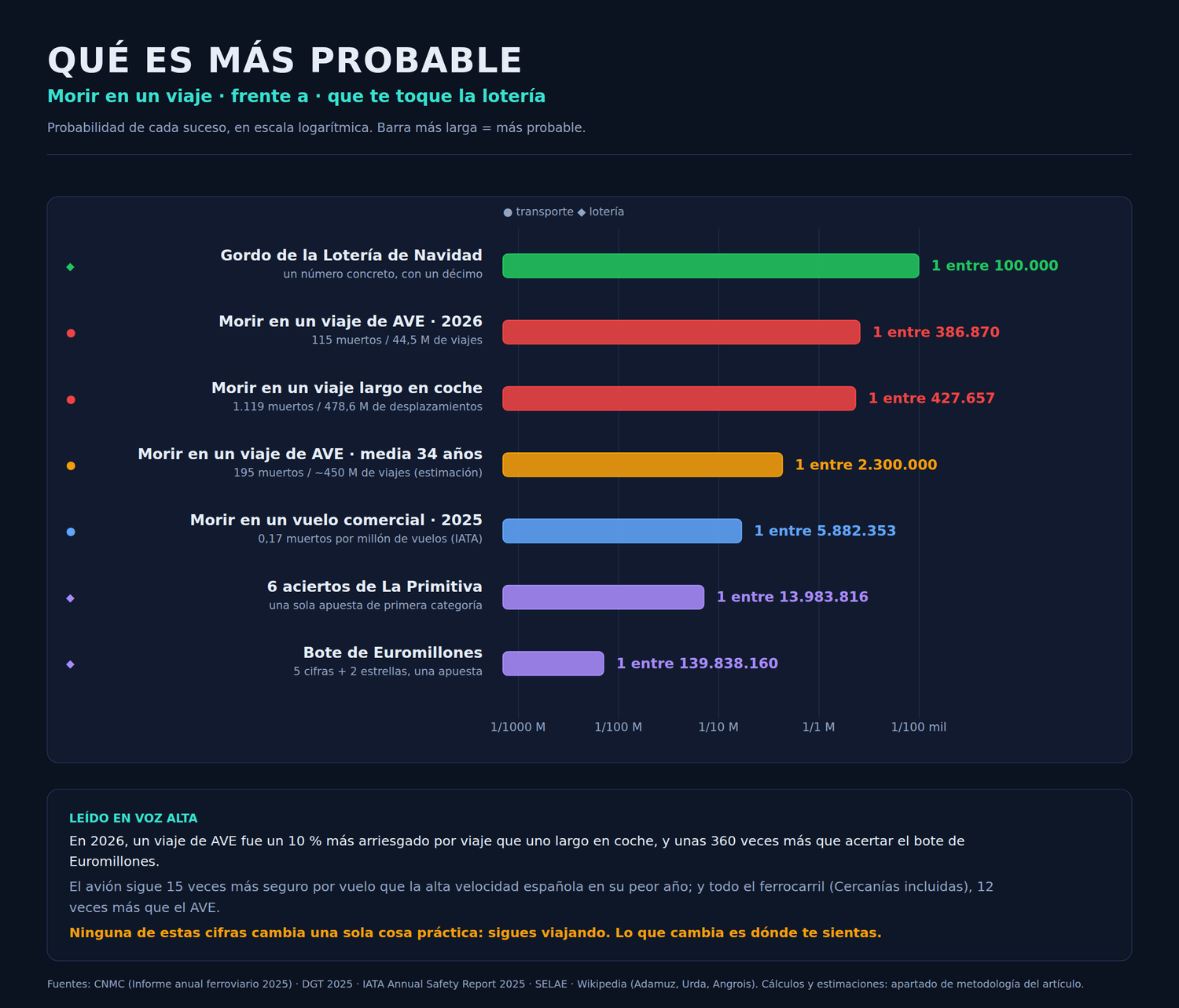
Here is the part that usually gets told badly. I put the risk of dying on a trip for each mode, and next to it what a lottery prize weighs. All on the same scale:
| Event | Calculation | Probability |
|---|---|---|
| Dying on an AVE trip in 2026 | 115 deaths / 44.5 M passengers | 2.58 per million → 1 in 387,000 |
| Dying on a long-distance car trip (2025) | 1,119 deaths / 478.6 M trips | 2.34 per million → 1 in 428,000 |
| Dying on an AVE trip, 34-year average | 195 deaths / ~450 M trips (estimate) | ~0.43 per million → 1 in 2.3 million |
| Dying on a commercial flight (2025) | 0.17 per million flights (IATA) | 1 in 5.9 million |
| Dying on any train in Spain (2026) | 115 deaths / 547 M passengers | 0.21 per million → 1 in 4.8 million |
| Winning the Christmas lottery top prize with one ticket | SELAE rules | 1 in 100,000 |
| Hitting all six numbers of La Primitiva | SELAE rules | 1 in 13,983,816 |
| Winning the EuroMillions jackpot | SELAE rules | 1 in 139,838,160 |
Read out loud:
- In 2026 an AVE trip was 10 % riskier per journey than a long-distance car trip. It has never happened before, and above all it is the sign that something has broken in how the infrastructure is managed.
- Flying remains about 15 times safer per journey than Spanish high-speed rail in its worst year. And rail as a whole is 12 times safer than the AVE in 2026.
- Winning the Christmas top prize is almost 4 times more likely than dying on an AVE trip this year. And dying on an AVE trip is around 360 times more likely than winning the EuroMillions jackpot.
- In “odds of half” terms: it would take 268,000 AVE trips to accumulate a 50 % chance of death at the 2026 rate. To reach 50 % on EuroMillions it would take 96.9 million bets: about €242 million.
Practical conclusion: the risk of a trip remains extremely low by any mode, and the difference between sitting in coach 2 or coach 6 is small inside that small number. But it is a free decision, and when something is free and points in the right direction, you take it.
What I would do
I still take the AVE, as I did in December. With two new habits: I book in the middle third of the formation and I check on the platform which end the cab is on before boarding. And if I travel with someone, we try not to sit in the same coach — the old aviation trick, and it costs nothing.
What I would not do is stop taking the train: even in the worst year in the history of Spanish high-speed rail, the risk per journey is on the order of one in hundreds of thousands. What I would demand — and this is what actually moves the numbers — is maintenance, signalling that doesn’t depend on a radio conversation, and an investigation that ends in changes rather than in a resignation.
Methodology
How I got the deaths per coach. From the Spanish and English Wikipedia articles on each accident, which in turn cite the investigation reports (CIAF, Ministry of Transport) and the national press. The specific data I use — coach 6 as the first to derail at Adamuz, the 19 and 10 deaths in coaches 1 and 2 of the Alvia, the 7 in the Iryo’s coach 8, the four tail coaches crushed and thrown down the embankment at Urda, the order in which vehicles left the track at Angrois — is referenced there. I cross-checked Spanish against English and discarded anything that appeared in only one of them.
A figure with two readings: Angrois. The consolidated figure, and the one in the court verdict, is 79 deaths; 80 is the number that kept circulating (it includes a victim whose death was attributed to a pre-existing illness aggravated by the accident). For the historical total I use 195, the sum the press works with (80 + 46 + 69); with 79 it would be 194. It changes no conclusion.
Units that are not homogeneous. This is the most important part of this section, and I repeat it in case anyone copies the figures:
- The high-speed figure divides 2026 deaths by 2025 passengers (44.5 million, the last year closed by the CNMC). If 2026 trips fell — and the CNMC’s own quarterly series suggest they did after the accidents — the real 2026 rate would be even higher. I used the optimistic denominator.
- The DGT counts vehicle trips of long distance, not people. A car with four occupants counts as one. That understates the per-person risk of car travel; the AVE runs full, so the real comparison is even worse for the train than it looks.
- The IATA figure is deaths per million flights, not per kilometre. A long-haul flight covers far more than a Madrid–Seville AVE, so per kilometre flying would be even more favourable. And it is a global figure for member airlines, not a Spanish one.
- I did not use deaths per passenger-kilometre because I could not find a 2026 Spanish series in that unit for high-speed rail. If someone has it, the per-kilometre comparison would leave the car considerably worse and the AVE somewhat better than the per-journey view.
The “34-year average” row is my estimate, not a published figure. The deaths (195) are documented; the denominator does not exist in published form. I added up CNMC series (44.5 M in 2025, 40 M in 2024, and “double the 2019 figure”, which gives 22.25 M) and extrapolated backwards for 1992-2018 at an average of 9-10 M trips a year, because the AVE went from under a million passengers in 1993 to some 20 million in 2018. Total: around 450 million trips. A ±50 % error margin is easy, so I use it only as an order of magnitude: even with that margin, 2026 was between 3 and 9 times worse than the historical average.
How I calculated the “odds of half”. With the Bernoulli trial formula: n = ln(0.5) / ln(1 − p), where p is the probability of the event in a single attempt. It is the number of trips (or bets) needed for the event to become more likely than not to happen at least once.
What does not exist. There is no study by the CIAF, the UIC or the European Union Agency for Railways publishing a probability of death by position inside a train. The recommendation to sit in the core is not a statistical law: it is a mechanical inference from three cases, with everything that implies about a small sample. Put honestly: three accidents are not a database, and the fact that the middle was not the impact point in all three could be luck.
Sources
- CNMC — 2025 annual rail sector report (press release, 17/07/2026): 44.5 million high-speed passengers and 547 million across rail as a whole in 2025.
- The Objective — “La tasa de mortalidad de la alta velocidad ya es superior a la del coche tras Adamuz y Urda” (31/10/2026): 115 deaths set against the CNMC and DGT series (1,119 deaths on interurban roads and 478.56 million long-distance trips in 2025), and the comparison with the 163 passengers killed in high-speed accidents in the rest of the world.
- IATA — Annual Safety Report 2025 (9/03/2026): fatality risk of 0.17 per million flights in 2025 (0.06 in 2024; 2021-2025 average 0.12), 38.7 million flights and 51 accidents.
- Wikipedia — Accidente ferroviario de Adamuz: the derailment sequence (coach 6), the three tail coaches on the opposing track, the four-metre embankment and the split of the 46 deaths by train and by coach.
- Wikipedia — 2026 Toledo train collision (Urda): the LZB failure at 8:30, the “normal running” authorisation, the rear-end strike at 160-200 km/h, 544 passengers (147 + 397), 69 deaths.
- Wikipedia — Accidente ferroviario de Santiago de Compostela (Angrois): the thirteen-vehicle formation, the order in which vehicles left the track, coach 4 on the wall, the burning rear trailer, 79 dead and 144 injured.
- Ministry of Transport — CIAF statement on the Adamuz accident: the investigation committee’s actions.
- Loterías y Apuestas del Estado: official EuroMillions, La Primitiva and National Lottery rules and probabilities. Aggregated tables at sortier.es.
Both images are my own work based on these data. The poster and the chart were generated as SVG and the chart’s figures are calculated, not copied: the formula and the assumptions are in the methodology section.
Automatically translated from the Spanish original.